


Introduction
Cloud GTM has become one of the most impactful revenue strategies in enterprise software today. Buying behaviour in the business technology world is shifting. Organizations are increasingly turning to cloud marketplaces and cloud ecosystems as preferred software procurement channels. As a result, software companies must adapt their go-to-market motions to meet buyers where they already spend their budgets.
Cloud GTM, or cloud go to market, is the strategic framework that software vendors use to capture this growing opportunity. Instead of relying solely on traditional direct sales, channel partners, or independent resellers, cloud GTM aligns products, sales teams, and partner programs with cloud platforms such as Amazon Web Services (AWS), Microsoft Azure, and Google Cloud. These platforms act as revenue channels where customers can discover, evaluate, and buy software solutions using existing cloud contracts.
The adoption of cloud marketplaces is not incremental. A recent industry report found that the number of unique marketplace buyers has grown by more than 460 percent over the past four years, and marketplace transaction activity increased by 70 percent in the past year alone, confirming that cloud marketplaces are no longer niche but mainstream purchasing channels.
Why does this matter for business leaders? Cloud GTM transforms how software is sold and bought. It accelerates sales cycles because procurement and legal reviews are simplified. It increases average deal sizes as buyers bundle software purchases into larger cloud commitments. In many cases, marketplace transacting customers are more likely to renew, leading to higher lifetime value.
For example, AWS reports more than 330,000 active customers regularly conduct software purchases through AWS Marketplace, and deals transacted through the marketplace close faster and often result in higher overall spend compared to traditional channels.
This guide is designed for decision makers, revenue leaders, and founders who want a complete and strategic understanding of cloud GTM. You will learn what cloud GTM is, how it works, why it matters, and how to build and scale a cloud GTM motion using cloud marketplaces like AWS Marketplace as a central revenue engine.
Whether you are preparing to evolve your go to market motion or already have early cloud GTM initiatives underway, this pillar page will give you the framework and data you need to make informed strategic decisions.

What is cloud GTM
Cloud GTM stands for cloud go to market and it represents a modern approach to selling software that aligns with how enterprises purchase technology today. Unlike traditional go‑to‑market strategies that depend heavily on direct sales forces, reseller networks, or offline procurement cycles, cloud GTM integrates software vendors directly into the cloud ecosystems where customers already operate and spend.
At its core, cloud GTM is about meeting buyers in the environments they trust and prefer. Enterprises increasingly have multi‑million dollar cloud commitments with hyperscaler providers such as AWS, Azure, and Google Cloud. Instead of asking buyers to engage in separate licensing negotiations, cloud GTM allows software solutions to be discovered, purchased, and deployed through existing cloud platforms. This reduces friction, shortens sales cycles, and aligns directly with existing budget structures.
Cloud GTM combines marketplace listing, co‑sell alignment with cloud partners, pricing strategies optimized for cloud procurement, and operational processes that make it easier for customers to buy and adopt software through their cloud provider of choice. It is not merely a distribution channel but a strategic business engine with measurable impact on revenue, pipeline, and customer acquisition.
How cloud GTM differs from traditional go to market
Traditional go to market strategies rely on a structured process that often includes outbound sales, manual procurement cycles, long contract negotiations, and significant legal overhead. Sales teams prospect, demo, negotiate, and then wait for legal and procurement to finalize terms before a deal can close. This process can take several months or longer for enterprise customers.
In contrast, cloud go to market leverages the infrastructure and trust of cloud providers to deliver a faster, more streamlined buying experience. Cloud marketplaces provide standardized purchasing agreements, integrated billing, and simplified compliance checks. Because the customer already trusts the cloud provider and has an existing commercial relationship, software can be purchased without starting an entirely new contractual relationship.
This creates a significantly different buying journey. Instead of long manual processes, a portion of the sales motion happens at the point of purchase within the cloud environment. This transforms buying into something closer to self service purchasing, but with commercial validation and enterprise‑ready procurement built in.
Why cloud GTM is strategic for modern software companies
Cloud GTM is not just a tactical channel. It is a strategic framework that influences product packaging, pricing models, partner engagement, sales compensation plans, and revenue forecasting. As enterprise buyers increasingly adopt cloud‑first procurement practices, companies that operate without a cloud go‑to‑market motion risk missing a large segment of revenue opportunities.
According to industry research from Tackle, cloud marketplace spend continues to expand rapidly. Marketplace influenced deals grow faster and close sooner than traditional enterprise deals because they align with cloud consumption patterns and existing budget commitments. This makes cloud go to market a critical component of modern revenue strategy for high‑growth companies.
By making software available inside cloud ecosystems, organizations gain exposure to a broader audience of buyers, benefit from marketplace discovery mechanisms, and can leverage cloud providers’ co‑sell capabilities to accelerate pipeline and drive higher conversion.
This section lays the foundation for deeper concepts such as how cloud GTM works in practice, why AWS Marketplace is a central pillar of cloud GTM strategies, and how private offers and cloud partner programs drive enterprise adoption.
What is cloud go to market and how it works
Cloud go to market, or cloud GTM, is more than just a method of selling software. It is a comprehensive approach that aligns product, sales, and partner strategies with cloud ecosystems to accelerate revenue and improve buyer experience. Understanding how cloud go to market works is critical for business leaders and SaaS companies looking to scale in 2026.
At a high level, cloud GTM works by embedding your product within the cloud platform where your buyers already operate. Instead of relying solely on traditional sales processes, the software is discovered, evaluated, and purchased directly through the cloud marketplace or with the support of the cloud provider’s co‑sell programs.
The buyer journey in cloud GTM
- Discovery: Buyers often start their search for software directly in cloud marketplaces like AWS Marketplace, or through recommendations from cloud provider account teams. Marketplace discovery is powered by search, categories, ratings, and reviews. According to AWS data, more than 330,000 active customers are transacting software through AWS Marketplace, demonstrating that buyers are actively using marketplaces as their first point of discovery.
- Evaluation: Cloud GTM allows buyers to test or evaluate software in their existing cloud environment. Products are often pre‑configured for deployment, making it easier for technical teams to pilot solutions without lengthy integration projects. This evaluation step is faster than traditional methods because the software runs in a familiar cloud environment, reducing internal IT barriers.
- Purchase: Once the evaluation is complete, buyers purchase directly through the cloud platform. This could be a self-service purchase or through a private offer negotiated for enterprise accounts. Purchases are tied to existing cloud contracts, which simplifies budgeting and eliminates the need for new procurement processes.
- Adoption: Because the software is already running in the cloud, adoption is often faster. Technical and business teams can start using the solution immediately, accelerating time to value. Cloud billing integration and cloud-native compliance also reduce post-purchase friction.
How software companies implement cloud GTM
Implementing cloud GTM requires more than just listing a product in a marketplace. Companies typically combine the following elements:
- Marketplace Listing: Products are made available in cloud marketplaces with optimized descriptions, pricing, and deployment options. This step is critical for discovery. Resources like AWS Marketplace seller guide provide detailed guidance.
- Private Offers and Pricing Strategy: For larger enterprise deals, cloud GTM includes private offers that allow for custom pricing, volume discounts, and contract terms. These are essential for maintaining flexibility while benefiting from marketplace simplicity. Learn more about AWS Marketplace private offers.
- Co-Sell Alignment with Cloud Providers: Aligning with cloud provider sales teams allows vendors to reach high-value customers. AWS, for example, has co-sell programs where their sales teams can introduce marketplace solutions to enterprise buyers, effectively amplifying the vendor’s sales reach.
- Operational Readiness: Data from marketplace transactions is integrated into CRM and analytics platforms, enabling teams to track pipelines influenced by cloud GTM. This provides actionable insights and ensures deals are prioritized based on customer readiness.
Key advantages of cloud GTM
- Faster deal cycles: Buyers can purchase without waiting for lengthy internal procurement and legal approvals.
- Lower customer acquisition costs: Marketplace visibility reduces the need for expensive outbound marketing and sales campaigns.
- Higher win rates: Alignment with cloud provider sales and procurement teams increases credibility and trust.
- Scalable reach: One listing can expose the product to thousands of enterprises globally.
According to a report on cloud GTM adoption, more than 82 percent of software vendors see increased pipeline velocity and deal size after implementing a cloud GTM motion, proving that this approach directly drives measurable business results.
Why cloud GTM is reshaping enterprise software sales
Cloud GTM is no longer a supplemental channel. It is transforming the very way software is bought, sold, and consumed in the enterprise. The shift toward cloud-based procurement and marketplace adoption is fundamentally changing sales cycles, deal structures, and customer relationships.
The shift from traditional sales to cloud GTM
Traditional enterprise software sales often involve long cycles with multiple touchpoints. A typical deal might include:
- Manual procurement reviews
- Legal and compliance approvals
- Extensive contract negotiations
- Long deployment and integration timelines
These processes are time-consuming, costly, and often unpredictable. As a result, sales teams spend more time chasing administrative approvals than focusing on revenue-generating activities.
In contrast, cloud GTM streamlines the process. By leveraging marketplaces and cloud provider ecosystems, vendors can meet buyers where they already operate. Purchases are made directly in the cloud, contracts are simplified, and billing is handled through the existing cloud account. This eliminates friction, accelerates decision-making, and reduces the burden on internal teams.
Impact on sales cycles and deal size
Cloud GTM shortens the time from discovery to purchase. According to a Tackle report on cloud marketplaces, deals transacted through cloud marketplaces close on average 30 to 40 percent faster than traditional sales channels. This is because buyers can evaluate, purchase, and deploy software within the same cloud ecosystem, bypassing lengthy procurement and legal review processes.
In addition to faster sales, cloud GTM often leads to larger deals. Enterprises buying through cloud marketplaces frequently bundle multiple software purchases or include volume-based pricing in private offers. AWS Marketplace, for example, reports that enterprise buyers transacting via private offers often spend 20 to 50 percent more per deal than standard marketplace purchases, reflecting the strategic value of marketplace-aligned sales.
Improved customer acquisition and retention
Cloud GTM also changes the way vendors acquire and retain customers:
- Lower acquisition costs: Marketplace visibility reduces the need for expensive outbound campaigns and sales prospecting. Buyers find products in environments they already trust.
- Higher win rates: Alignment with cloud provider co-sell teams increases credibility and introduces solutions to buyers at the right stage.
- Stronger retention and expansion: Software purchased through cloud platforms is more likely to be renewed or expanded because it is already integrated into the customer’s cloud environment and billing system.
A McKinsey study on digital sales transformations highlights that companies using cloud marketplaces for software sales see a 25 to 35 percent increase in customer retention rates, compared to traditional channels.
Why enterprises prefer cloud GTM
Enterprise buyers are increasingly seeking simplicity and speed. Cloud GTM allows them to:
- Purchase software with pre-approved cloud budgets
- Reduce legal and compliance review time
- Deploy and evaluate software in their existing cloud environment
- Access pricing and contract flexibility via private offers
This combination of speed, convenience, and flexibility explains why cloud GTM is rapidly becoming the preferred mode of enterprise software procurement. Companies that fail to adopt cloud GTM risk losing visibility and deals to competitors who are more aligned with modern buying behavior.

The core components of a cloud GTM strategy
A successful cloud GTM strategy is more than listing a product on a cloud marketplace. It is a structured framework that aligns product, sales, marketing, finance, and partnerships to meet buyers where they already operate. Companies that execute well create a scalable, repeatable revenue engine that drives faster sales cycles, larger deal sizes, and higher retention.
Below are the key components of a cloud GTM strategy.
1. Cloud marketplaces
Cloud marketplaces are the foundation of cloud GTM. These platforms, such as AWS Marketplace, Azure Marketplace, and Google Cloud Marketplace, serve as the primary discovery and purchasing channel for enterprise buyers.
Marketplaces allow vendors to:
- Showcase products to thousands of potential customers
- Offer self-service trials and software deployment
- Simplify billing and procurement by integrating with existing cloud accounts
For example, AWS Marketplace has over 330,000 active customers and supports both small business purchases and enterprise-level private offers. This makes marketplaces a critical pillar for any cloud GTM motion. Learning AWS Marketplace listing and understanding AWS Marketplace benefits is essential for building this component.
2. Cloud provider partner programs
Partner programs are the second pillar of cloud GTM. Cloud providers like AWS offer co-sell programs that allow vendors to leverage the provider’s sales and partner network to reach high-value customers.
Key benefits include:
- Access to cloud provider sales teams for enterprise opportunities
- Marketing support and joint demand generation
- Opportunity to participate in co-sell incentives
Co-sell motions help vendors amplify their reach, gain credibility, and reduce customer acquisition costs. Integrating partner programs into your GTM strategy is crucial for scaling deals, especially at the enterprise level.
3. Cloud procurement and billing integration
One of the most significant advantages of cloud GTM is the alignment with cloud-based procurement. When software is available through a marketplace, buyers can use pre-approved budgets and purchase with minimal legal or finance friction.
Cloud procurement benefits include:
- Faster approvals and deal closures
- Integration with existing cloud billing
- Simplified contract management
- Support for private offers with negotiated pricing
For enterprise deals, tools like AWS Marketplace private offers enable customized pricing and contract flexibility while maintaining the simplicity of marketplace transactions.
4. Data, CRM, and operational readiness
Operational readiness is the final pillar of cloud GTM. Data from marketplace transactions must be integrated into internal CRM and analytics systems. This ensures sales, marketing, and finance teams can track pipelines influenced by cloud GTM and prioritize deals efficiently.
Operational elements include:
- Tracking marketplace-sourced revenue and influenced pipeline
- Automating deal workflows and notifications
- Monitoring adoption and retention metrics
- Linking marketplace transactions to internal sales dashboards
Companies that ignore operational readiness risk underutilizing cloud GTM as a growth engine. Effective use of cloud GTM solutions ensures end-to-end visibility, scalable operations, and actionable insights.
Putting it all together
The core components of a cloud GTM strategy work together to create a repeatable growth engine:
- Marketplaces provide discovery and procurement
- Partner programs amplify reach and credibility
- Cloud procurement reduces friction and accelerates deals
- Operational readiness enables data-driven decisions and scalable execution
Together, these components form the backbone of a cloud-first go-to-market motion that aligns with modern enterprise buying behavior and maximizes revenue potential.
AWS Marketplace as a cloud GTM engine
Among cloud marketplaces, AWS Marketplace is one of the most mature and widely used platforms, making it a central component of many cloud GTM strategies. For software vendors looking to accelerate growth, AWS Marketplace is more than just a listing platform, it is a revenue engine that connects your product with thousands of enterprise buyers worldwide.
Why AWS Marketplace matters
AWS Marketplace provides a trusted environment where customers can discover, evaluate, and purchase software that integrates with their existing cloud infrastructure. This trust reduces the friction traditionally associated with enterprise software procurement.
- Global reach: AWS Marketplace is available in over 190 countries, giving vendors access to a worldwide customer base.
- Active buyers: There are more than 330,000 active AWS customers who regularly purchase third-party software, representing a large pool of potential leads.
- Integrated billing: Purchases are billed directly through the customer’s AWS account, eliminating the need for separate invoices or complex procurement processes.
These features make AWS Marketplace a natural foundation for any cloud GTM strategy. By listing products here, vendors align with where buyers are already making decisions.
How AWS Marketplace supports cloud GTM
AWS Marketplace enables several cloud GTM motions that accelerate revenue:
- Self-service discovery and purchase
Buyers can search for products, compare solutions, and deploy software in a few clicks. This allows smaller teams and faster-moving buyers to transact without heavy sales involvement. - Private offers for enterprise deals
For larger customers, vendors can provide AWS Marketplace private offers that include negotiated pricing, volume discounts, and custom contract terms. These offers maintain the simplicity of the marketplace while supporting complex enterprise procurement. - Co-sell with AWS sales teams
AWS actively promotes co-selling with vendors listed in the marketplace. By participating in AWS partner programs, companies can leverage the provider’s sales teams to introduce their solution to enterprise accounts, increasing credibility and pipeline velocity. - Compliance and security assurances
AWS Marketplace handles aspects like compliance checks, licensing, and security certification. Buyers feel confident purchasing software that meets enterprise-grade cloud standards.
Why AWS Marketplace is a revenue accelerator
Data shows that companies using AWS Marketplace as part of their cloud GTM strategy experience measurable growth:
- Shorter sales cycles: Deals can close 30 to 40 percent faster than traditional channels due to simplified procurement.
- Higher deal sizes: Enterprise customers using private offers often spend 20 to 50 percent more than standard transactions.
- Improved retention: Customers who purchase through AWS Marketplace are more likely to renew and expand usage, as the software is integrated directly into their cloud environment.
For SaaS vendors, these benefits translate into a more predictable and scalable revenue engine. Following the AWS Marketplace seller guide are essential steps to unlock these advantages.
Making AWS Marketplace central to your cloud GTM strategy
To fully leverage AWS Marketplace, companies should:
- Optimize product listings with clear messaging and technical details
- Enable private offers to capture enterprise deals
- Align sales and partner teams with marketplace-driven pipeline
- Integrate marketplace transactions with internal CRM and analytics systems
When done correctly, AWS Marketplace not only increases visibility and deal velocity but also strengthens the overall cloud GTM motion, turning marketplaces into a predictable revenue channel rather than a one-off sales tactic.
How cloud GTM works on AWS
Understanding how cloud GTM works on AWS is critical for software vendors who want to scale effectively. AWS Marketplace is not just a listing platform, it is a comprehensive sales channel that enables discovery, evaluation, and purchase inside the cloud ecosystem. When executed well, it can significantly shorten sales cycles, increase deal sizes, and improve customer retention.
Step 1: Listing your product on AWS Marketplace
The first step in any cloud GTM motion on AWS is getting your product listed. This ensures your solution is discoverable by thousands of potential buyers who are actively searching for software in the marketplace.
Key steps include:
- Preparing your product package with cloud-ready deployment options
- Defining pricing, including subscription or usage-based models
- Meeting AWS security, compliance, and certification requirements
- Creating optimized listing content with clear messaging and technical documentation
Step 2: Enabling discovery and evaluation
Once listed, the next step is to make your product easy for buyers to discover and evaluate. AWS Marketplace supports:
- Search optimization with categories, tags, and keywords
- Customer reviews and ratings
- Free trials or test deployments to encourage evaluation
This stage is critical because buyers often compare multiple solutions before purchasing. A clear, well-structured listing that addresses technical, operational, and financial questions increases the likelihood of conversion.
Step 3: Purchasing via self-service or private offers
AWS Marketplace enables flexible purchasing options:
- Self-service purchase: Smaller teams or fast-moving buyers can transact instantly with minimal sales involvement. This reduces friction and accelerates time to value.
- Private offers: For enterprise customers or large deals, vendors can provide custom pricing and contract terms. Private offers maintain marketplace simplicity while allowing for negotiations and volume discounts. Learn more about AWS Marketplace private offers.
By offering both self-service and private options, vendors can address a wider range of buyers, from small teams to large enterprises.
Step 4: Deployment and adoption
Cloud GTM does not end with the purchase. Adoption is faster because software runs natively in the buyer’s cloud environment. Benefits include:
- Instant deployment and configuration inside AWS
- Reduced integration challenges with existing cloud infrastructure
- Faster realization of value and improved satisfaction
- Simplified renewals and expansions since billing is handled through AWS
Integrating operational data from AWS Marketplace into internal CRM systems allows vendors to track adoption metrics, retention, and revenue growth. This operational readiness is a critical component of a sustainable cloud GTM strategy.
Step 5: Driving revenue through cloud GTM on AWS
When all steps are aligned, AWS Marketplace becomes a powerful revenue engine:
- Deals close 30 to 40 percent faster due to simplified procurement
- Enterprise customers spend 20 to 50 percent more with private offers
- Marketplace-driven transactions contribute to predictable pipeline and revenue
To maximize results, vendors should optimize listings, enable private offers, align with AWS co-sell teams, and integrate operational data into sales and marketing systems. For SaaS vendors, platforms that help list and sell on AWS Marketplace simplify these workflows and accelerate growth.
Private offers and enterprise cloud GTM
For enterprise deals, self-service marketplace purchases are often not enough. This is where private offers become a critical component of any cloud GTM strategy. Private offers allow vendors to negotiate custom pricing, contract terms, and volume discounts for individual customers while still transacting through AWS Marketplace.
What are private offers
A private offer is a customized deal created by a software vendor within AWS Marketplace for a specific customer or set of customers. Unlike standard listings, private offers allow:
- Custom pricing tailored to the enterprise’s needs
- Flexible contract terms such as multi-year commitments or special SLAs
- Volume-based discounts to encourage larger purchases
- Single-click procurement through the AWS billing system
These deals maintain the simplicity of cloud-based transactions while accommodating the complexities of enterprise procurement. Learn more about AWS Marketplace private offers and how they fit into a cloud GTM motion.
Why private offers are essential for cloud GTM
Private offers bridge the gap between marketplace self-service and traditional enterprise sales. They are particularly valuable for:
- Large enterprise accounts
Enterprises often have unique requirements for pricing, security, or integration. Private offers allow vendors to meet these requirements without leaving the marketplace. - Accelerating procurement
Because private offers are processed through the AWS billing system, enterprises can bypass lengthy internal procurement processes. Deals that would traditionally take months to close can now be completed in weeks. - Driving higher deal sizes
Customized pricing and volume discounts encourage larger purchases. According to AWS data, enterprise buyers using private offers often spend 20 to 50 percent more than standard marketplace transactions. - Co-sell alignment with AWS
Vendors participating in private offer programs can leverage AWS co-sell teams. AWS sales representatives introduce solutions to key accounts, further increasing pipeline velocity and credibility.
How to integrate private offers into your cloud GTM strategy
Implementing private offers effectively requires coordination across product, sales, and operations:
- Product packaging: Ensure your product can scale across multiple instances or cloud regions to meet enterprise deployment needs.
- Sales enablement: Train sales teams to identify accounts that would benefit from private offers and align with AWS co-sell resources.
- Operational processes: Track private offer deals in CRM systems to ensure accurate revenue recognition and pipeline reporting.
- Customer success: Monitor adoption post-purchase and leverage cloud billing data to identify expansion opportunities.
By incorporating private offers into your cloud GTM strategy, vendors can capture enterprise deals faster, increase average deal size, and maintain marketplace simplicity for buyers.
Benefits of private offers in the enterprise context
- Faster enterprise adoption: Custom deals remove procurement hurdles.
- Increased customer lifetime value: Buyers are more likely to renew or expand usage.
- Strategic alignment with cloud providers: Co-sell programs improve pipeline quality and credibility.
- Operational efficiency: All transactions remain within AWS Marketplace, simplifying billing, compliance, and reporting.
Private offers are a cornerstone of modern cloud GTM strategies. They enable vendors to scale enterprise sales in a predictable, repeatable way without sacrificing the simplicity that makes cloud marketplaces appealing to buyers.
Benefits of AWS Marketplace for cloud GTM
AWS Marketplace is more than a software catalog. For modern SaaS companies, it acts as a strategic growth channel that drives faster revenue, higher deal sizes, and better customer retention. Understanding the benefits of AWS Marketplace is essential for decision-makers designing a cloud GTM strategy.
1. Faster sales cycles
One of the biggest advantages of AWS Marketplace is the acceleration of the sales process. By enabling buyers to purchase software directly through the cloud platform, vendors eliminate delays caused by traditional procurement, legal, and finance processes.
- Deals closed via AWS Marketplace can be 30 to 40 percent faster compared to traditional channels.
- Buyers use existing cloud budgets, eliminating the need for new purchase approvals.
For SaaS companies, this speed translates into quicker revenue recognition and faster ROI on GTM investments. Learn more about the benefits of AWS Marketplace for software vendors.
2. Access to a global customer base
AWS Marketplace has over 330,000 active customers across more than 190 countries. This provides SaaS vendors with unparalleled access to enterprises of all sizes without the need for extensive sales infrastructure in each market.
- Vendors can reach new buyers in multiple regions without building local sales teams.
- Marketplace listings enhance visibility and credibility for software solutions.
This global exposure makes AWS Marketplace a core channel for companies looking to scale internationally.
3. Increased deal sizes with private offers
AWS Marketplace supports private offers, allowing vendors to provide custom pricing, contract terms, and volume discounts for enterprise accounts. Private offers help capture larger deals while still leveraging the simplicity of the marketplace.
- Enterprise buyers using private offers often spend 20 to 50 percent more than standard transactions.
- Vendors can align co-sell programs with AWS to further amplify deal size and pipeline quality.
Learn more about AWS Marketplace private offers and how they integrate into a cloud GTM strategy.
4. Simplified billing and compliance
Purchases made through AWS Marketplace are billed directly through the buyer’s AWS account. This simplifies financial operations and compliance:
- Vendors do not need to issue separate invoices or track multiple procurement processes.
- AWS Marketplace handles tax, licensing, and contract management for transactions.
- Buyers gain confidence in software security and compliance because all products meet AWS standards.
This operational simplicity reduces friction for both vendors and buyers, enabling smoother transactions and faster revenue recognition.
5. Stronger customer retention and expansion
Software purchased through AWS Marketplace is easier for buyers to adopt because it integrates directly with their cloud environment. This leads to higher engagement and retention:
- Customers who purchase via AWS Marketplace are more likely to renew subscriptions and expand usage.
- Vendors can leverage marketplace data to identify cross-sell and upsell opportunities.
The combination of speed, simplicity, and integration makes AWS Marketplace a revenue engine rather than just a distribution channel.
6. Co-sell opportunities with AWS
Vendors listed on AWS Marketplace can participate in co-sell programs where AWS sales teams help introduce solutions to enterprise buyers. This alignment:
- Increases credibility and visibility with strategic accounts
- Accelerates pipeline velocity
- Enhances marketing reach without additional spend
This co-sell alignment is a unique advantage of AWS Marketplace compared to other distribution channels.
Summary of benefits for cloud GTM:
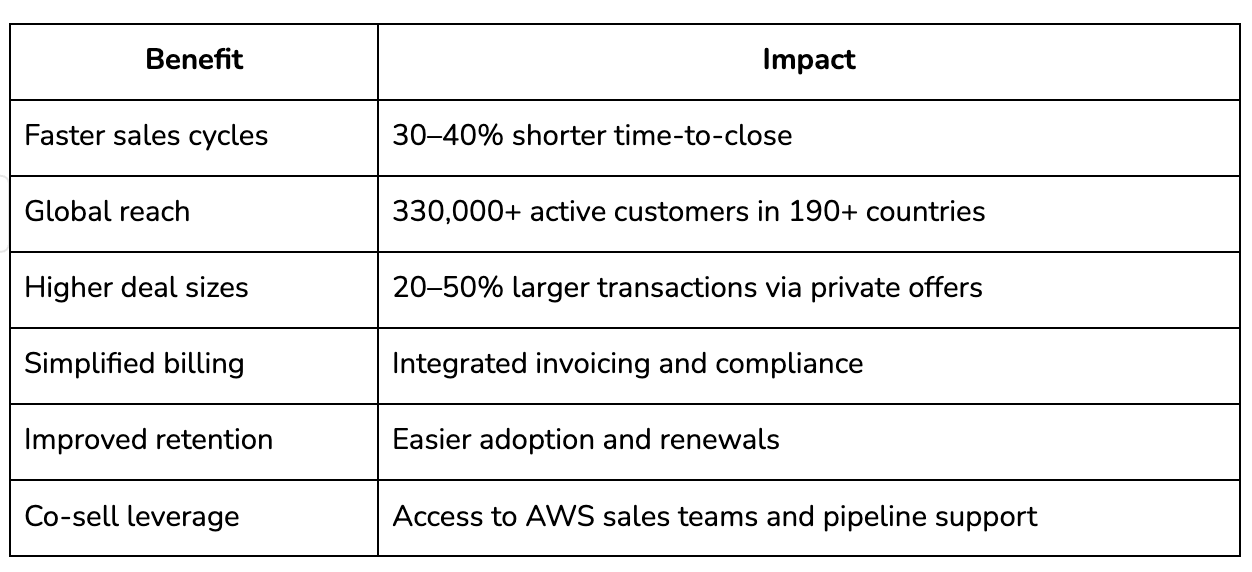
For SaaS vendors building a cloud GTM strategy, AWS Marketplace is not just a listing, it is a revenue accelerator that aligns perfectly with modern enterprise buying behavior.

What makes the best cloud GTM strategy
A successful cloud GTM strategy is not just about listing your product on a marketplace. The best strategies align product, sales, marketing, finance, and partnerships to create a repeatable, scalable revenue engine. Companies that implement top-performing cloud GTM strategies consistently outperform peers in speed, deal size, and retention.
1. Align product packaging with cloud buyers
Cloud buyers expect software that is easy to deploy, scale, and manage in their existing cloud environments. The best cloud GTM strategies focus on:
- Offering cloud-native deployment options
- Providing flexible pricing models such as subscription, consumption-based, or BYOL (bring your own license)
- Designing solutions for rapid evaluation and trial within the cloud platform
Optimized product packaging ensures buyers can experience value quickly, which accelerates adoption and revenue recognition.
2. Enable self-service and private offer flexibility
Modern cloud GTM strategies balance self-service purchasing for smaller accounts with private offers for enterprises.
- Self-service: Enables buyers to discover, evaluate, and purchase software independently through platforms like AWS Marketplace.
- Private offers: Allow vendors to negotiate custom pricing, multi-year contracts, or volume discounts for enterprise deals. See AWS Marketplace private offers.
This dual approach maximizes reach while meeting enterprise complexity requirements.
3. Leverage cloud provider co-sell programs
Co-sell programs with cloud providers are a multiplier for growth. Vendors listed on marketplaces can collaborate with AWS, Azure, or Google Cloud sales teams to reach strategic enterprise accounts. Benefits include:
- Increased credibility with buyers
- Faster pipeline development
- Access to enterprise accounts that may be difficult to reach otherwise
Top cloud GTM strategies integrate co-sell programs into their sales and marketing processes to amplify reach and impact.
4. Integrate operational and CRM readiness
Operational readiness is often overlooked but critical for scaling cloud GTM. The best strategies ensure that:
- Marketplace transactions feed directly into CRM and analytics platforms
- Sales and finance teams have visibility into pipeline, revenue recognition, and deal progress
- Marketing can track which campaigns influence cloud marketplace adoption
Using cloud GTM solutions helps automate these workflows, providing accurate reporting and enabling data-driven decision-making.
5. Optimize for customer success and expansion
A cloud GTM strategy does not end at purchase. Leading companies focus on adoption, retention, and expansion:
- Use cloud billing and deployment data to monitor usage and identify upsell opportunities
- Provide proactive support to reduce churn
- Align customer success and account management teams with cloud GTM motions
This ensures the flywheel effect, where faster adoption leads to renewals and expansions, which feed back into predictable revenue growth.
6. Continuous improvement through data
Finally, the best cloud GTM strategies are iterative. Companies track metrics such as:
- Marketplace-sourced revenue
- Cloud-influenced pipeline
- Time-to-close metrics
- Customer adoption and retention
Analyzing these metrics allows companies to refine product packaging, pricing, and co-sell efforts continuously, creating a sustainable growth engine.
Summary of best practices for cloud GTM
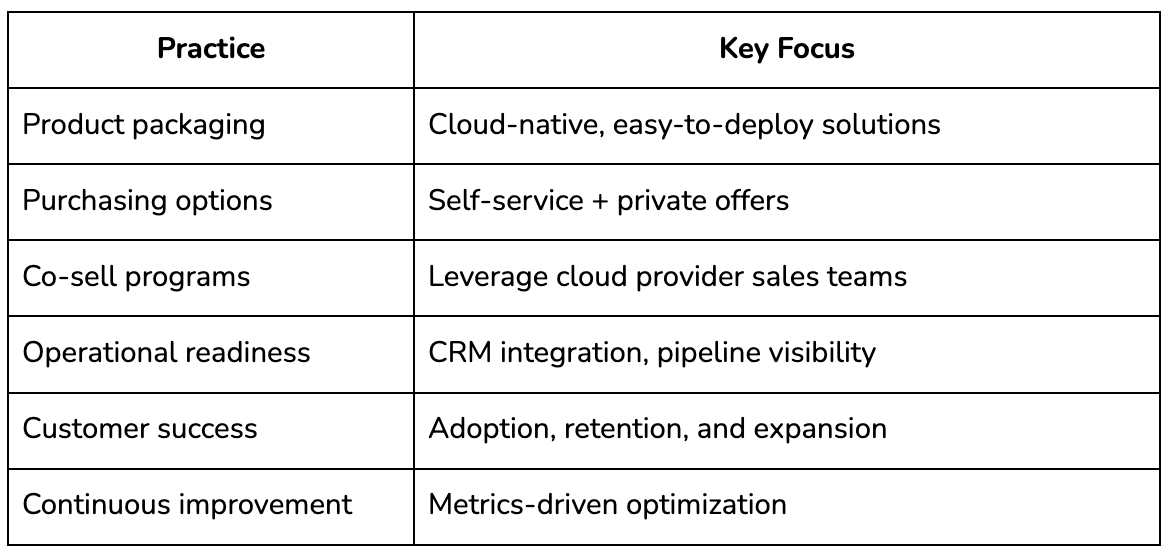
By combining these elements, vendors can create a cloud GTM strategy that accelerates revenue, reduces friction, and positions the company for long-term success in cloud marketplaces.
Cloud GTM solutions and why they matter
As cloud go-to-market strategies mature, it becomes clear that executing cloud GTM manually is both time-consuming and error-prone. Modern SaaS vendors increasingly rely on cloud GTM solutions to automate workflows, track transactions, and scale operations efficiently.
What are cloud GTM solutions
Cloud GTM solutions are software platforms and tools designed to manage the end-to-end process of selling software through cloud marketplaces and cloud provider ecosystems. These solutions typically help vendors:
- List and manage products across multiple marketplaces
- Automate deal processing, including private offers and subscriptions
- Integrate marketplace transaction data with internal CRM and analytics systems
- Track metrics such as pipeline influence, deal velocity, and customer adoption
For vendors targeting AWS, using dedicated cloud GTM solutions for AWS simplifies the process of listing, selling, and reporting while ensuring compliance and operational readiness.
Why cloud GTM solutions are essential
- Operational efficiency
Without automation, managing multiple listings, pricing tiers, and private offers can become overwhelming. Cloud GTM solutions streamline these processes, reducing manual errors and freeing teams to focus on growth. - Data-driven insights
Marketplace transactions provide a wealth of data, but it is only valuable if integrated into your operational and sales systems. Cloud GTM solutions capture this data in real-time, enabling revenue leaders to make informed decisions and optimize pipeline prioritization. - Scalability
As vendors expand across marketplaces or cloud providers, manual processes quickly become bottlenecks. Cloud GTM solutions allow teams to scale without proportionally increasing headcount or operational complexity. - Improved alignment across teams
These platforms provide a single source of truth for product, sales, marketing, and finance teams, ensuring everyone is aligned on GTM performance, customer adoption, and revenue recognition.
How cloud GTM solutions support AWS Marketplace
For companies selling on AWS Marketplace, cloud GTM solutions offer specific advantages:
- Automated listing creation and updates, ensuring products remain visible and optimized
- Private offer management, allowing sales teams to create custom deals efficiently
- Revenue tracking, feeding marketplace-sourced deals into CRM for accurate forecasting
- Compliance monitoring, ensuring adherence to AWS Marketplace policies and certifications
Vendors that use these solutions can focus on strategy rather than operational minutiae, making AWS Marketplace a more effective revenue channel.
The business impact of cloud GTM solutions
Companies that invest in cloud GTM solutions report measurable improvements:
- Faster deal cycles due to automated workflows
- Higher win rates as private offers and co-sell programs are executed efficiently
- Better visibility into pipeline influenced by marketplaces
- Increased adoption and expansion by tracking usage and integrating with customer success teams
For SaaS vendors, cloud GTM solutions are no longer optional, they are a key enabler of predictable, scalable growth through cloud marketplaces.
How to get started with cloud GTM on AWS
Starting a cloud GTM strategy on AWS may seem complex, but a structured approach can help SaaS vendors launch quickly and effectively. By following proven steps, companies can leverage AWS Marketplace as a scalable revenue channel while optimizing for faster deals and higher adoption.
Step 1: Prepare your product for the cloud
Before listing on AWS Marketplace, ensure your product is cloud-ready:
- Verify that the software is compatible with AWS environments and can be deployed easily
- Consider packaging options, such as SaaS, AMI (Amazon Machine Image), or containerized solutions
- Ensure security, compliance, and operational documentation are complete
Proper preparation reduces friction for buyers and minimizes support issues post-launch.
Step 2: Create and optimize your AWS Marketplace listing
A marketplace listing is the primary interface with buyers. Key actions include:
- Craft clear and compelling product descriptions that highlight value and outcomes
- Include technical documentation, deployment guides, and pricing information
- Optimize listings for relevant keywords to improve discovery
- Leverage resources like how to list on AWS Marketplace for detailed instructions
Listings should speak directly to enterprise buyers, emphasizing speed, security, and ease of adoption.
Step 3: Enable private offers for enterprise deals
Private offers allow vendors to customize pricing, volume discounts, and contract terms for strategic customers. Steps to implement include:
- Identify accounts that require enterprise-level negotiations
- Configure private offers in AWS Marketplace to accommodate custom pricing or multi-year contracts
- Align with AWS co-sell teams to reach key accounts efficiently
Private offers make AWS Marketplace suitable not only for small or medium buyers but also for large enterprise deals. Learn more about AWS Marketplace private offers.
Step 4: Align sales, marketing, and customer success teams
Effective cloud GTM requires cross-functional alignment:
- Sales: Understand marketplace processes and co-sell programs
- Marketing: Optimize listings, drive awareness, and generate demand through AWS campaigns
- Customer Success: Monitor adoption, engagement, and expansion opportunities
Using cloud GTM solutions can simplify this alignment by centralizing marketplace data and workflows.
Step 5: Track metrics and iterate
Once your product is live, measure the impact of your cloud GTM strategy:
- Marketplace-sourced revenue and influenced pipeline
- Deal velocity and conversion rates
- Customer adoption, retention, and expansion
- Feedback from co-sell programs and private offers
Regularly analyzing these metrics allows continuous improvement, ensuring your cloud GTM strategy scales effectively.
Step 6: Scale across regions and product lines
After initial success, SaaS vendors can expand their cloud GTM efforts:
- Add additional products or modules to AWS Marketplace
- Enter new geographic regions
- Launch campaigns leveraging AWS co-sell and partner programs
Scaling thoughtfully ensures your cloud GTM motion remains efficient and predictable while capturing the growing enterprise cloud market.
Next steps for SaaS vendors
To start, vendors can explore, list and sell on AWS Marketplace to simplify the operational setup and accelerate GTM execution. By following these steps, companies can turn AWS Marketplace into a core revenue channel and position themselves for long-term success in cloud marketplaces.
Cloud GTM metrics that leadership should track
Measuring the effectiveness of a cloud GTM strategy is essential for ensuring predictable revenue, scalable growth, and successful adoption. Leaders must focus on metrics that align with both financial performance and operational execution.
1. Marketplace-sourced revenue
This metric tracks the direct revenue generated from transactions on cloud marketplaces such as AWS Marketplace. It allows leadership to understand the tangible impact of cloud GTM efforts.
- Includes both self-service purchases and private offer deals
- Helps identify top-performing products and categories
- Enables revenue forecasting for cloud GTM initiatives
2. Cloud-influenced pipeline
Not all cloud GTM transactions result in immediate purchases. Many deals are influenced by marketplace visibility and co-sell engagement. Metrics here include:
- Number of opportunities originating from AWS Marketplace exposure
- Deals influenced by co-sell or private offers
- Pipeline velocity and conversion rates
Tracking this KPI ensures leadership understands the broader impact of cloud GTM beyond immediate transactions.
3. Deal velocity and sales cycle time
Cloud GTM should accelerate the buying process. Key metrics include:
- Average time from discovery to purchase
- Average time for private offer deals to close
- Comparison of marketplace transactions vs traditional sales
According to Tackle research, deals transacted through cloud marketplaces close 30–40 percent faster than traditional channels, highlighting the importance of monitoring cycle times.
4. Customer adoption and retention
The ultimate goal of cloud GTM is not just closing deals but driving long-term customer success. Metrics to track include:
- Product adoption rates post-purchase
- Customer renewal rates
- Expansion and upsell opportunities generated through cloud GTM
Using cloud GTM solutions allows teams to integrate adoption data from AWS Marketplace into CRM and analytics systems.
5. Co-sell and partner engagement effectiveness
For enterprise GTM motions, leadership should track:
- Number of deals influenced or accelerated by cloud provider co-sell teams
- Revenue contribution from co-sell engagements
- Partner-driven pipeline growth
This helps evaluate the effectiveness of aligning with cloud provider ecosystems and optimize co-sell programs for maximum ROI.
6. Operational efficiency metrics
Operational readiness is critical for scaling cloud GTM. Track:
- Time to launch new listings or updates
- Private offer processing efficiency
- Accuracy of revenue recognition and reporting
Monitoring these metrics ensures cloud GTM processes are efficient and scalable.
Why tracking metrics matters
By tracking these key KPIs, leadership gains:
- Visibility into the ROI of cloud GTM investments
- Actionable insights to optimize listings, pricing, and co-sell programs
- Predictable revenue forecasting from cloud marketplaces
- Data-driven decisions on scaling cloud GTM strategies across products and regions
Together, these metrics allow decision-makers to understand the health and effectiveness of their cloud GTM motion, make strategic adjustments, and ensure sustainable growth.
Why choosing the right cloud GTM partner matters
Selecting the right cloud GTM services provider can significantly impact:
- Time to market: Accelerates listing, offer creation, and co-sell enablement
- Deal size and velocity: Optimized listings and private offer management increase revenue
- Operational efficiency: Reduces manual overhead and improves CRM integration
- Customer adoption and retention: Streamlined GTM motions drive faster adoption and higher renewals
Many Cloud GTM experts have proven track records in helping SaaS companies implement scalable cloud GTM strategies that align with AWS Marketplace and other cloud ecosystems.
Conclusion and key takeaways
The cloud landscape is rapidly evolving, and cloud GTM strategies are no longer optional; they are essential for SaaS vendors aiming to scale revenue, shorten sales cycles, and strengthen customer relationships. From marketplaces like AWS to private offers, co-sell programs, and operational readiness, cloud GTM provides a repeatable, scalable, and data-driven approach to reaching enterprise buyers.
Key takeaways for decision-makers
- Marketplaces are central to GTM success
Platforms like AWS Marketplace enable buyers to discover, evaluate, and purchase software seamlessly. Vendors gain faster deals, larger transactions, and global reach. - Private offers unlock enterprise potential
Custom pricing, multi-year contracts, and volume-based deals allow vendors to capture high-value accounts without sacrificing the simplicity of cloud transactions. Learn more about AWS Marketplace private offers. - Operational readiness drives scalability
Integrating marketplace data into CRM, automating workflows, and leveraging cloud GTM solutions ensures teams can scale GTM efforts efficiently. - Metrics and data are critical
Tracking marketplace-sourced revenue, cloud-influenced pipeline, deal velocity, adoption, and retention allows leaders to make informed, data-driven decisions. - Future-proof your GTM strategy
Stay ahead by adopting AI-driven insights, multi-cloud expansion, subscription-based models, and private offer optimization to align with evolving buyer expectations. - Partner with experts for faster execution
Companies like Applify, provide technology and expertise to simplify marketplace operations and accelerate cloud GTM adoption.
Call to action
SaaS vendors ready to unlock the full potential of cloud GTM should start by listing their products on AWS Marketplace and leveraging solutions that simplify operations, enable private offers, and integrate co-sell programs. With the right strategy, tools, and execution, cloud GTM becomes more than a sales channel, it transforms into a strategic growth engine for predictable revenue, faster adoption, and long-term enterprise success.
Explore how you can list and sell on AWS Marketplace today and position your SaaS business for accelerated growth in the cloud.